Master Your Vision with the Canva Vision Board Planner
There is a specific kind of clarity that comes from seeing your goals laid out in front of you. As creative professionals, we often talk about the importance of a strong brand identity, but we rarely apply that same strategic rigor to our personal or business roadmaps. A mood board is fine for aesthetics, but a Vision Board Planner is where strategy meets visualization. This specific Canva Planner template isn't just about pasting pretty pictures; it is about constructing a visual hierarchy for your future.
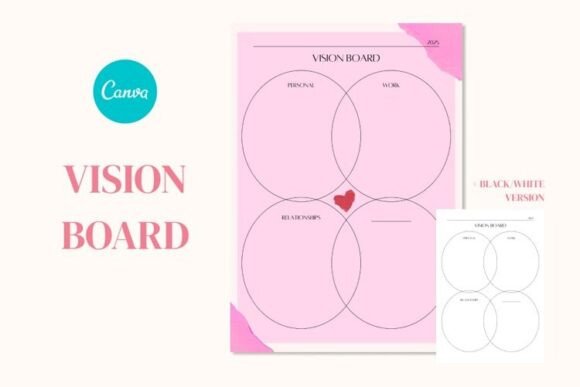
What makes this tool stand out in a crowded market of design assets is its versatility. It arrives as an instant download containing a zip archive with a PDF instruction file and a direct link to Canva. Once you open the link on your desktop, you are greeted with a clean, intuitive interface. The product includes two distinct pages: a vibrant color version and a stark black-and-white version. This duality is crucial. The color version allows for emotional resonance and branding consistency, while the monochrome version strips away distraction, focusing purely on the content and layout structure.
The Designer's Approach to Goal Setting
When we look at the visual characteristics of this planner, it functions much like a well-designed editorial design layout. It does not scream for attention with unnecessary ornamentation. Instead, it offers a modern, clean aesthetic that acts as a canvas. Think of it less as a rigid template and more as a flexible typeface—a foundation that supports the weight of your actual goals without overpowering them.
The appeal here is professionalism. For entrepreneurs and small business owners, a vision board is often seen as a "soft" tool. However, by placing your objectives within a structured Canva Planner, you elevate the practice. It transforms a collage of dreams into a strategic document. You can use this for social media graphics planning, mapping out a packaging design rollout, or even plotting a content calendar. The layout encourages you to prioritize, much like how a premium font demands attention through its weight and placement.
Practical Applications Across Industries
This planner is not limited to personal use. For marketers, it serves as a visual brief. For bloggers and content creators, it is a storyboard for the year ahead. Here is how different professionals can leverage this template:
- Brand Strategists: Use the board to map out the evolution of a client's brand identity. Place competitor analysis next to desired color palettes and font pairing explorations.
- Graphic Designers: Treat it as a project mood board. Before opening Illustrator, drop your display font options and serif font candidates onto the board to see how they interact with your proposed imagery.
- Entrepreneurs: Visualize the "vibe" of your upcoming launch. If you are selling a commercial font or a digital product, this board helps you see the whole ecosystem—website, email headers, and ads—in one glance.
The inclusion of both color and black-andwhite versions is a subtle nod to web design principles. The color version tests your palette in a real-world context, ensuring your chosen hues maintain readability and contrast. The black-andwhite version is perfect for testing visual hierarchy. If your goals are clear and prioritized in grayscale, they will work in any medium.
Customization and Workflow Integration
One of the biggest hurdles with digital planners is the learning curve. This Vision Board Planner solves that by utilizing Canva, a platform familiar to most creatives. The instructions provided in the PDF are straightforward, guiding you to the template link so you can start customizing immediately.
From a typography standpoint, the template is a playground. Because the base design is neutral, you can apply various creative fonts to categorize different sections of your life or business. You might use a handwritten font for personal aspirations to add a touch of warmth, while sticking to a rigid sans serif font for financial targets to imply stability and logic.
Consider the readability of your final board. Just as you would test a web design prototype, you should step back from your vision board to ensure the key elements pop. Are the most critical goals buried under decorative elements? Use the layout to create a focal point. This is where modern typography rules apply: contrast is king. If your images are busy, use bold, clean text overlays.
Finalizing Your Strategy
The true value of this product lies in its ability to bridge the gap between abstract ideas and concrete plans. It is a design asset that adapts to you. Whether you are a crafter looking to organize your next project or a publisher planning a quarterly content strategy, the structure provided by this Canva Planner ensures that nothing falls through the cracks.
Remember, a vision board is a living document. Because this is a digital template, you can duplicate the pages. Create one for Q1, and another for Q3. Use the color version for the annual overview and the black-andwhite version for weekly execution. This flexibility is what separates a static image from a functional planning tool. By treating your goals with the same respect you give your client work—using professional design assets